It is a hobby of mine to collect assumptions in the scientific method as I have a personal interest in philosophy in general, and the philosophy of science in specific. I try to keep them to a bare minimum and disprove assumptions, usually analytically. So, in this blog post, I am going to list some assumptions general to the scientific method that I do not think the method would work without, and give some commentary. I would appreciate input on the assumptions listed, as well as suggestions for further assumptions.
If there are Laws in nature, then those laws do not change with respect to time or space.
I don't think its necessary to assume that Laws do, in fact, exist, because science is a inductive process based in empiricism. So, if Laws exist, we will observe them -- they are not assumed to exist. However, because of the nature of science to build on the work of others, and because it sometimes takes time to fully understand the limits of a theory (Look at Newton)
, we assume that the Laws do not change from one time to another. They are, in this sense, eternal. I think it is better to state the assumption like this than to say that "Time Exists" or
"Space Exists" or "Laws Exist", because these are things that are either difficult to define outside of empirical definitions, or they are things that we do not know exist. If Time does not exist, then of course the laws won't change with respect to time, because a non-existent entity can't effect an existing one. It also doesn't presuppose that we will actually find order in the universe. We hope to find order, sure, but we can't say that we will find order without performing an experiment.
Our Physical World is Deterministic
This is an assumption that I've come to question as of late. I state "Physical World" because science only deals with the physical world. Further, the scientific method does not deal with any other possible physical world, but the one in which we live, because that is the only one which we can empirically verify, which is the highest form of verification in scientific inquiry. However, the term "Deterministic" is one that requires a bit of elucidation.
If by "Deterministic" all we mean is "Physical Laws can not be violated" then I am fine with the assumption of Determinism as an assumption (or, really, that's more of a definition). However, philosophically speaking, Determinism has a much wider meaning. Generally it means that every event from the beginning of time was determined before all events occurred. This can be demonstrated with a Thought Experiment: Supposing we know the physical laws of a photon, and we are present to observe the beginnings of the universe, then we can determine, through a long series of calculations, exactly where the photon is going to go.
However, I do not think we assume Determinism. I think by saying that Determinism is a major assumption in the scientific method, we're putting the cart before the horse. Rather, the evidence amassed through the scientific method suggests that our physical universe is a deterministic one. However, even within the confines of Monism (that the universe does not have any parrelel realities that act in different ways. Generally compared to Dualism, which is generally attributed to Descartes), and that Monism is our Physical Universe, things aren't necessarily deterministic in the grand sense that everything is predetermined before it happens. Rather, it is deterministic in the sense that physical laws can not be violated, and so action is limited, but only within the confines of physical laws, not completely Deterministic as it is usually defined.
There is a Truthful connection between our mind and the Universe
This is a recent one I came upon, so I haven't thought about it as much. It basically assumes that science, in general, is coming closer to the truth about things, rather than the truth about the way we think about things. There is no logical reason for assuming this, but it seems to be working so far. It's the sort of assumption one makes if they either believe in Dualism, or are not purely empirical, such as that demonstrated by David Hume. Science, dealing with Induction to understand data, and Deduction as means for formulating Hypothesis's and understanding of several Induction's, does not only deal with pure empiricism. Rather, it hops between "Types". These types are somewhat separate unto themselves and can be regarded as "Methods to Knowledge".
EDIT: Going through these posts again, I've realized that I've changed the most on this post. I fully disagree assumption 1 and 2, and I think "assumption" 3 can be well argued for, and therefore doesn't count as an assumption -- though it may have to be argued for in a "philosophic" sense, so it may still be an assumption within the domain of science if one accepts that these things are distinctly different at this point.
Monday, June 29, 2009


Wednesday, June 3, 2009
Colloids
With summer comes employment, and with employment comes less learning, and with less learning comes less blogging. In addition, my summer studies are centering around broader philosophical studies than what is topical for this blog, so expect a decrease in posting for the summer months.
However, during a pub-crawl with my friends a few weeks ago, the subject of colloids came up. I poured the beer out too fast, and it foamed over. I knew foam to be a colloid, I knew alloys to be colloids, but I had no recollection of what distinguished a colloid from a solution. Both are heterogeneous mixtures of substances with molecules dispersed fairly regularly throughout a medium. Generally, solutions are liquids that have solids dissolved in them, though they can also have a combination of liquids. Colloids don't have a specified state: In fact, the type of colloid depends upon the states of the dispersion medium (analogous to the solvent) and the thing being dispersed through that medium (analogous to the solute). So, really, in a prima facie way, it seems that colloids are just a more general terminology for solutions.
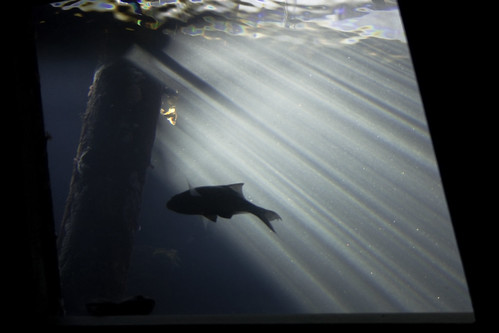
So I broke out my gen-chem book, and found out I was mistaken -- the difference between colloids and solutions is the size of the molecules, or groups of molecules. In both, a molecule or ion is solvated, or completely surrounded by the solution. But in a colloid, the groups of molecules are much larger, between 1 * 10^3 pm to 1 * 10^6 pm (picometers). For comparison, the bond length of a Helium to Helium molecule is 300 picometers. Another common example of a colloid is found in soap -- when soap molecules interact with grease, they embed into the grease while keeping a single part of the soap molecule on the outside of the grease. The part embedded in the grease is attracted to oily things, and the part on the outside of the grease is attracted to water -- so running water will then push the grease along. This is a colloid composed of a clump of molecules attracted to each other, but dispersed in another medium, and much larger than a molecule in a solution. Another good day-to-day example of colloids can be seen if you go for a walk at the park. If you've seen light streaming through the branches, this is because the light is reflecting off of dust in the air. In fact, this is a common way to distinguish between colloids and solutions, and is known as the Tyndall effect (this picture demonstrates a colloid of a solid in a liquid). The molecules in a solution are so small that they don't interfere with the visible light spectrum, but the molecules or groups of molecules in a colloid are large enough to do so.
So this brought me to another question regarding chemical philosophy: While we can observe the Tyndall effect to distinguish between colloids and solutions, do the sizes of the molecules matter very much aside from the fact that they interact with visible light? I've done kinetics experiments revolving around a solutions ability to absorb light. So, even though we can't observe the interaction with our eyes, the molecules do still interact with light, don't they? Is the terminology of solutions a bit too simplistic? After all, there is a point in solutions where you have to ask, what is the solvent and what is the solute? What if you have more than two liquids and a solid? Proteins can grow to reach sizes like this, and yet they are only one molecule solvated by water. Does that make our DNA colloidal, and what point does this distinction elucidate? After all, we could also just say that solutions with really big particles in them interact with the visible light spectrum and be done with it. But then we'd be expanding the terms of solution to include things that are clearly not mixed in the same way that salt water is mixed, such as mayonnaises, or beer foam. But they are also slightly different from a solid block of, say, iron. But just because there seems to be this odd in between zone where we're uncertain about how to classify and understand given solutions, it seems rather ad-hoc to just make up a term and rationalize a distinction. So, what's the point of colloids, and what terms should we use in distinguishing between types of solutions, if indeed we ought to revise them at all? I'm going with the ambiguous and open-ended ending.
However, during a pub-crawl with my friends a few weeks ago, the subject of colloids came up. I poured the beer out too fast, and it foamed over. I knew foam to be a colloid, I knew alloys to be colloids, but I had no recollection of what distinguished a colloid from a solution. Both are heterogeneous mixtures of substances with molecules dispersed fairly regularly throughout a medium. Generally, solutions are liquids that have solids dissolved in them, though they can also have a combination of liquids. Colloids don't have a specified state: In fact, the type of colloid depends upon the states of the dispersion medium (analogous to the solvent) and the thing being dispersed through that medium (analogous to the solute). So, really, in a prima facie way, it seems that colloids are just a more general terminology for solutions.
So I broke out my gen-chem book, and found out I was mistaken -- the difference between colloids and solutions is the size of the molecules, or groups of molecules. In both, a molecule or ion is solvated, or completely surrounded by the solution. But in a colloid, the groups of molecules are much larger, between 1 * 10^3 pm to 1 * 10^6 pm (picometers). For comparison, the bond length of a Helium to Helium molecule is 300 picometers. Another common example of a colloid is found in soap -- when soap molecules interact with grease, they embed into the grease while keeping a single part of the soap molecule on the outside of the grease. The part embedded in the grease is attracted to oily things, and the part on the outside of the grease is attracted to water -- so running water will then push the grease along. This is a colloid composed of a clump of molecules attracted to each other, but dispersed in another medium, and much larger than a molecule in a solution. Another good day-to-day example of colloids can be seen if you go for a walk at the park. If you've seen light streaming through the branches, this is because the light is reflecting off of dust in the air. In fact, this is a common way to distinguish between colloids and solutions, and is known as the Tyndall effect (this picture demonstrates a colloid of a solid in a liquid). The molecules in a solution are so small that they don't interfere with the visible light spectrum, but the molecules or groups of molecules in a colloid are large enough to do so.
So this brought me to another question regarding chemical philosophy: While we can observe the Tyndall effect to distinguish between colloids and solutions, do the sizes of the molecules matter very much aside from the fact that they interact with visible light? I've done kinetics experiments revolving around a solutions ability to absorb light. So, even though we can't observe the interaction with our eyes, the molecules do still interact with light, don't they? Is the terminology of solutions a bit too simplistic? After all, there is a point in solutions where you have to ask, what is the solvent and what is the solute? What if you have more than two liquids and a solid? Proteins can grow to reach sizes like this, and yet they are only one molecule solvated by water. Does that make our DNA colloidal, and what point does this distinction elucidate? After all, we could also just say that solutions with really big particles in them interact with the visible light spectrum and be done with it. But then we'd be expanding the terms of solution to include things that are clearly not mixed in the same way that salt water is mixed, such as mayonnaises, or beer foam. But they are also slightly different from a solid block of, say, iron. But just because there seems to be this odd in between zone where we're uncertain about how to classify and understand given solutions, it seems rather ad-hoc to just make up a term and rationalize a distinction. So, what's the point of colloids, and what terms should we use in distinguishing between types of solutions, if indeed we ought to revise them at all? I'm going with the ambiguous and open-ended ending.
Saturday, May 16, 2009
Just one little drop...
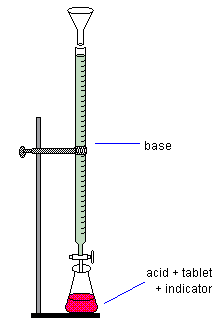
A chemist stands, swirling an Erlenmeyer flask with a small sample of liquid in the bottom, holding the flask up to a Buret that drips liquid into it. It drips at a rate of about 1 drop every 2 seconds, and Oddly, the two liquids combining are clear, but each time the liquid from the Buret comes into contact with the liquid in the Erlenmeyer flask, a bright pink liquid evolves, and disappears in the swirling motion of the chemicals. Then, the chemist notices how the pink liquid dissipates at a slower rate, so he slows the rate in order to observe the reaction of every drop. One drop is added. The chemist swirls, and the pink disappears. Another drop is added. The solution in the Erlenmeyer begins to fully turn pink, but with a little swirling, it slowly goes clear. Almost there, the chemist allows half of a bead of liquid to form, and stops the rate entirely. He pulls out a stirring rod, and grabs the half-bead with it, then swirls it into the Erlenmeyer solution. The solution turns a mild shade of pink, but does not dissipate. The experiment is over -- but what just happened, and why was the chemist interested in it?
This was a description of a Titration experiment. This is an analytical tool for determining how much chemical stuff is dissolved in a known amount of liquid, and the bane of students in General Chemistry II. It combines the ideas of atoms, ions, dissolution, chemical reactions, and moles -- that's a lot of theory, and while I realize everyone knows what an atom is, I don't know if everyone will remember what an ion is, or why salt dissolves in water. Nonetheless, I don't think its absolutely necessary to fully understand these concepts to get the gist of what a Titration is all about.
Take some baking soda (do it!), and put some of it into two different cups -- I put 1/2 teaspoon into two coffee cups. Then fill one of the cups with water halfway, and the other one quarter of the way up with water. Break out the household vinegar, and a tablespoon, and drop one tablespoon of vinegar into each glass, and watch what happens. Keep doing this. (this can get messy, so it might be best to do this in the sink) This is a little rough, but when I did it at home, it seemed to illustrate the point -- you'll notice that bubbles stop forming with roughly equal amounts of vinegar, even though one cup has twice the amount of water in it. This suggests that the water has nothing to do with the reaction, just the baking soda and the vinegar.
That's because it's true -- the water is the medium through which the chemical reaction takes place, or in chemical parlance the "solvent". It's where the chemicals you're interested in float around, find each other, and react.
Just so you know, there is a chemical reaction going on between the water and the chemicals you're interested in, but it has nothing to do with the one that evolves the bubbles, and is called "Dissolution". Basically, it's what happens when you put sugar in your milk, or when you mix salt and water. The water molecule separates all the molecules packed together in that grain of sugar or salt and surrounds them, which is what renders them "invisible", since molecules are too small to see all by themselves.
Now, back to titration -- that's basically what you performed in the kitchen! But there are a few differences.For starters, chemist's use instruments that are known to produce better accuracy and precision. This is primarily a quantitative experiment, which leads to the next point of difference: Normally, the liquid in the Erlenmeyer flask has an unknown amount of chemicals you're interested in in it. You usually know that it's in water, or can easily tell, and you can tell what type of chemical you need to react with it with litmus paper. Further, when preparing a chemical to react with the unknown, you have complete control: You can measure the amount of chemical you dissolve into water. Then, you react a known amount of chemical with an unknown amount of chemical, and when the reaction doesn't happen anymore, you know that all of the unknown amount has reacted and that that unknown amount is equal to the amount of chemical you prepared to react with it.
One other little snag in this is, how do you know when a chemical reaction is complete? Most of them aren't as dramatic as the reaction between baking soda (Sodium Bicarbonate) and Vinegar (Acetic Acid). This is what the pink color was all about in the story above -- this is another chemical present in the mixture. It doesn't interfere with the reaction between the two chemicals you're interested in, but it changes color whenever your prepared chemical comes into contact with it. This way, if the pink disappears, you know that all of your prepared chemical reacted with the unknown chemical, and you continue. If pink stays, even just a little bit, then you know you've reached what is generally termed the "Equivalence Point" -- the point where a solution's pH changes dramatically from acidic to basic with the addition of a small amount of either an acid or a base.
This is why the chemist was taking so much care near the end of his experiment. It doesn't take a lot to accidentally go past the equivalence point. Even one little drop can add too much of your prepared chemical, and then your calculation for how much chemical amount was added will be off far enough that you'll have only a very rough idea of how much chemical amount was in the unknown, rather than a good idea.
Now, this can get much more complex, but the general idea holds: You have some unknown amount of molecules floating around in some water, and you want to know how many molecules are there. So you throw in a chemical that will react with those molecules, and when they're done reacting, you do a little math and figure out the unknown -- pssh, who says chemistry is hard to understand? It's just colors, numbers, and bubbles.
This was a description of a Titration experiment. This is an analytical tool for determining how much chemical stuff is dissolved in a known amount of liquid, and the bane of students in General Chemistry II. It combines the ideas of atoms, ions, dissolution, chemical reactions, and moles -- that's a lot of theory, and while I realize everyone knows what an atom is, I don't know if everyone will remember what an ion is, or why salt dissolves in water. Nonetheless, I don't think its absolutely necessary to fully understand these concepts to get the gist of what a Titration is all about.
Take some baking soda (do it!), and put some of it into two different cups -- I put 1/2 teaspoon into two coffee cups. Then fill one of the cups with water halfway, and the other one quarter of the way up with water. Break out the household vinegar, and a tablespoon, and drop one tablespoon of vinegar into each glass, and watch what happens. Keep doing this. (this can get messy, so it might be best to do this in the sink) This is a little rough, but when I did it at home, it seemed to illustrate the point -- you'll notice that bubbles stop forming with roughly equal amounts of vinegar, even though one cup has twice the amount of water in it. This suggests that the water has nothing to do with the reaction, just the baking soda and the vinegar.
That's because it's true -- the water is the medium through which the chemical reaction takes place, or in chemical parlance the "solvent". It's where the chemicals you're interested in float around, find each other, and react.
Just so you know, there is a chemical reaction going on between the water and the chemicals you're interested in, but it has nothing to do with the one that evolves the bubbles, and is called "Dissolution". Basically, it's what happens when you put sugar in your milk, or when you mix salt and water. The water molecule separates all the molecules packed together in that grain of sugar or salt and surrounds them, which is what renders them "invisible", since molecules are too small to see all by themselves.
Now, back to titration -- that's basically what you performed in the kitchen! But there are a few differences.For starters, chemist's use instruments that are known to produce better accuracy and precision. This is primarily a quantitative experiment, which leads to the next point of difference: Normally, the liquid in the Erlenmeyer flask has an unknown amount of chemicals you're interested in in it. You usually know that it's in water, or can easily tell, and you can tell what type of chemical you need to react with it with litmus paper. Further, when preparing a chemical to react with the unknown, you have complete control: You can measure the amount of chemical you dissolve into water. Then, you react a known amount of chemical with an unknown amount of chemical, and when the reaction doesn't happen anymore, you know that all of the unknown amount has reacted and that that unknown amount is equal to the amount of chemical you prepared to react with it.
One other little snag in this is, how do you know when a chemical reaction is complete? Most of them aren't as dramatic as the reaction between baking soda (Sodium Bicarbonate) and Vinegar (Acetic Acid). This is what the pink color was all about in the story above -- this is another chemical present in the mixture. It doesn't interfere with the reaction between the two chemicals you're interested in, but it changes color whenever your prepared chemical comes into contact with it. This way, if the pink disappears, you know that all of your prepared chemical reacted with the unknown chemical, and you continue. If pink stays, even just a little bit, then you know you've reached what is generally termed the "Equivalence Point" -- the point where a solution's pH changes dramatically from acidic to basic with the addition of a small amount of either an acid or a base.
This is why the chemist was taking so much care near the end of his experiment. It doesn't take a lot to accidentally go past the equivalence point. Even one little drop can add too much of your prepared chemical, and then your calculation for how much chemical amount was added will be off far enough that you'll have only a very rough idea of how much chemical amount was in the unknown, rather than a good idea.
Now, this can get much more complex, but the general idea holds: You have some unknown amount of molecules floating around in some water, and you want to know how many molecules are there. So you throw in a chemical that will react with those molecules, and when they're done reacting, you do a little math and figure out the unknown -- pssh, who says chemistry is hard to understand? It's just colors, numbers, and bubbles.
Friday, May 8, 2009
Crystals
So, the end of semester is here, and summer looms at me with its tasty treats of indolence and self-education. With that, I'm looking back over the past semester, and trying to think of the most important things I learned. While actually comparing knowledge in terms of importance is, IMO, somewhat meaningless, it's good to think back about what you learned, and answering this question is an excellent catalyst for that type of intellectual probing. It's a toss-up between my physics course, and my organic course. In my physics course chemical theory suddenly clicked. Working problems starting from the basic SI units helped me understand what I was talking about when I was talking about the energy in a system, or in understanding the derivation of the gas laws. Still, while theory is important to understand, and this helped clarify chemical theory for me, I have an even more difficult time in connecting theory to experience -- in lab I often feel like I'm just pouring two liquids together, and shit happens, while in a lecture exam, some Grignard reagent attacks a ketone which is then protonated in a second step by a dilute acid. It's a world of imaginary particles and rationalized diagrams, where the lab is a world of color changing liquids. I have to actively think about theory after an experience to connect the two together, so because of that, I think the most important discovery I made was a personal fascination with crystals.
In organic chemistry, in most labs, we would combine liquids to form crystals. Place a liquid with some sort of chemical dissolved in it contained within a beaker into a water-ice bath, and observe. Initially, pure liquid. Then, slowly, small specks of a solid begin to form, barely noticeable. Without poking or prodding, the specks grow larger, clumping together, forming uniform shapes, even though they form independently of each other. These uniform shapes depend on the exact compound being created, but indeed, they are uniform. Look at common table salt -- each cube looks, more or less, as if they're a uniform shape. The same thing would happen in lab, only in different shapes, and it would happen by virtue of being surrounded by a cold source.
One day while recrystalizing a certain product, I made the connection to atoms. Small particles slowly clumping together in a uniform shape -- similar to crystals. Essentially, watching crystals form gave me an experiential understanding of atoms and compounds. It was the closest I could get, with the naked eye, to seeing atoms and compounds interacting. Now, the naked eye type of experience isn't necessary in understanding a given scientific concept, but I think it helped in my lab skills and in my understanding of an experiment. Suddenly, liquids weren't turning brown, but simple sugars were reacting with copper ion in Benedict's Reagent, Double bonds were attacking bromine, and esters were being cleaved by basic solutions to form soap. I felt more confident in using the framework of theoretical knowledge in order to understand an experimental situation. I saw the atoms reacting with one another, forming new compounds, and solidifying in energetically favorable positions. I watched crystals grow, and beheld the beauty and simplicity in the atomic theory of matter.
It's a sublime moment for me when theory is understood in experiental and experimental terms, and I sit back watching nature and feel like I actually understand what's going on. All the work involved in understanding the material -- my retraction from having as much of a social life, neglection of my hobbies, interruption of a normal sleep schedule, as well as the actual intellectual labor -- suddenly becomes worthwhile.
And to think I came back to school just to get a better job than working in a warehouse; I never thought I'd love science this much. But, there you have it -- I love crystals. I think they're the coolest things ever, and the purification of compounds by recrystalization has become my favorite process in lab. It reminds me of Primo Levi's description of distillation -- there's a certain elegance to the application of theory, and observing that elegance in action will always fascinate me.
In organic chemistry, in most labs, we would combine liquids to form crystals. Place a liquid with some sort of chemical dissolved in it contained within a beaker into a water-ice bath, and observe. Initially, pure liquid. Then, slowly, small specks of a solid begin to form, barely noticeable. Without poking or prodding, the specks grow larger, clumping together, forming uniform shapes, even though they form independently of each other. These uniform shapes depend on the exact compound being created, but indeed, they are uniform. Look at common table salt -- each cube looks, more or less, as if they're a uniform shape. The same thing would happen in lab, only in different shapes, and it would happen by virtue of being surrounded by a cold source.
One day while recrystalizing a certain product, I made the connection to atoms. Small particles slowly clumping together in a uniform shape -- similar to crystals. Essentially, watching crystals form gave me an experiential understanding of atoms and compounds. It was the closest I could get, with the naked eye, to seeing atoms and compounds interacting. Now, the naked eye type of experience isn't necessary in understanding a given scientific concept, but I think it helped in my lab skills and in my understanding of an experiment. Suddenly, liquids weren't turning brown, but simple sugars were reacting with copper ion in Benedict's Reagent, Double bonds were attacking bromine, and esters were being cleaved by basic solutions to form soap. I felt more confident in using the framework of theoretical knowledge in order to understand an experimental situation. I saw the atoms reacting with one another, forming new compounds, and solidifying in energetically favorable positions. I watched crystals grow, and beheld the beauty and simplicity in the atomic theory of matter.
It's a sublime moment for me when theory is understood in experiental and experimental terms, and I sit back watching nature and feel like I actually understand what's going on. All the work involved in understanding the material -- my retraction from having as much of a social life, neglection of my hobbies, interruption of a normal sleep schedule, as well as the actual intellectual labor -- suddenly becomes worthwhile.
And to think I came back to school just to get a better job than working in a warehouse; I never thought I'd love science this much. But, there you have it -- I love crystals. I think they're the coolest things ever, and the purification of compounds by recrystalization has become my favorite process in lab. It reminds me of Primo Levi's description of distillation -- there's a certain elegance to the application of theory, and observing that elegance in action will always fascinate me.
Monday, May 4, 2009
The Simplest Solution
Due to end-of-semester busyness, I was not able to update over the weekend. But, I want to try and stay on my self-assigned blog schedule, and now I'm just studying for finals, so a day late is better than a week, right?
I already had the idea that science tried to break things apart. But, generally, I always thought this was to find the most basic understanding of the universe -- to be able to explain causation from understanding the way that everything works. I think this is still a part of it, but there's another part to it too.
The human mind can only compute so much.
To demonstrate, see the following physics problem (and if you've had Physics I before, I'm sure you've solved this problem before):
A 1 kg rock is suspended by a massless string from one end of a 1 meter measuring stick. What is the mass of the measuring stick if it is balanced by a support force at the .25 meter mark?
I always find pictures to be useful when solving physics problems, so the first things first:

Really, that's about as complex as I normally draw, just to help me visualize a given scenario. In this problem, there is the word "Massless", which is just a fancy way of saying that the string that connects the rock to the meter stick doesn't have to be accounted for, so we're really just dealing with the rock, the meter stick, and the fact that the meter stick isn't moving even with the rock attached to it and the fact that the balancing point is located .25 meters away from where the rock is connected.
The main concept that needs to be applied here is the concept of Torque. Torque can be written in a number of ways, mathematically, but conceptually it's fairly simple, and related to my previous post talking about Force. When talking about Force, the examples and problems usually use cannon balls, footballs, or cars. That's because they easily relate to something called Translational Motion -- which is just the movement of an object from Point A to Point B. You throw a ball, it goes from your hand, Point A, to some spot on the ground, Point B, and there are a host of equations one can use to predict where that point will be based upon how hard you throw the ball, what angle you throw the ball at, and what the ball interacts with on the way there. These equations all have analogous equations that relate to another type of motion: Rotational Motion. Rotational motion is still motion, but it behaves differently than Translational Motion -- not so different that the Laws of the Universe are different, but we have to model them differently because their Translational motion would be a lot harder to model mathematically than it would if we were to just measure the motion of spinning things by the angles they travel through. So, really, it's still Point A to Point B motion, but instead of measuring things in meters, where the direction would constantly be changing, you measure things in Θ (Theta), a generic symbol meaning "Angle".
Torque is the rotational analogue to Force. But instead of F = ma, you have τ = Iα. τ is the Greek letter Tau, and it stands for Torque, which is rotational Force. α is the Greek letter alpha, and it stands for rotational acceleration (with units of radians/second^2, instead of meters/second^2).
This leaves "I". "I" stands for "Moment of Inertia", which does not explain itself as well as "Mass" does, so it requires a bit of explanation itself. Similarly to mass, if the Moment of Inertia is greater, it takes more Torque to gain a greater angular acceleration. But with rotational motion, you have to take more into account than the mass of an object. You also have to take into account how far away a mass is from the center of rotation. And, as you're actually dealing with a large number of particles all revolving around a single point (we'll call this point the "axle"), all of which may have different masses than each other, and most likely are at different lengths from the axle, this can easily get pretty complex. To be technically correct, you would have to find the distance a single particle is from the axle, find its mass, and compute its individual Moment of Inertia -- which is easy enough when you have only one particle. The equation for the Moment of Inertia of a single particle is "I=mr^2", where m is the mass and r is the distance from the axle. So, you square the distance of the particle from the axle, and multiply it by its mass. But when you're dealing with, say, a wheel, there are a lot of particles.
The way to then tackle a problem like the one above is the realize "Hey, this thing basically has an axle at .25 meters, and it has Torque being applied to that axle due to the Force of gravity. Even better than that, the thing isn't moving, so we know that the Torques are equal on both sides. So, the Torque of Left side is equal to the Torque of Right side, so I'll set their equations equal to one another. I know the mass of the rock, if I can figure out the Moment of Inertia for the Left side and the Moment of Inertia for the Right side, then I can find the mass of the meter stick".
Or, mathematically speaking, Iα(left) = Iα(right) from τ = Iα
This is where I made a mistake in tackling the above problem. There is a way to get around having to add up each individual particle, and in fact this simplification at least makes the moment of inertia calculable by hand. For example, when looking at pulleys (another favorite of physics problems) First, you assume that the particles are, more or less, the same mass, as the object is made of the same material -- a good assumption. Then, because the shape of a wheel is a regular shape where the outside of the wheel is equidistant from the axle, you can actually say "Hey! That pulley's a hellalot like a cylinder!", and make another assumption that is more or less correct: that the pulley will behave as if we had a perfect cylinder. The equation for the Moment of Inertia of a perfect solid cylinder is well known, so you can just plug it into the above equation and work away. It's 1/2mr^2, in case you're curious.
The problem is, the above problem is NOT a perfect cylinder, nor is it anywhere close to one. So, my first instinct was to go back to the basic definition for "I", where you can find "I" for any solid object (as that's what I'm dealing with). This involves integrating the volume of an object with respect to its mass which, quite honestly, is a pain in the ass -- at least for me. And actually, this is what I learned: It's not that there is anything wrong with taking the above approach, but you want to simplify the problem to make it easy, digestible, and understandable. And there is such a solution to the above problem, I just didn't see it initially.
It deals with a concept known as "Center of Mass". Center of Mass lets you treat a whole object as if it were a point particle. You mathematically find some fictional point near the object that the object will follow in motion, so you can use the equations you normally use for a point -- which are easier to deal with than whole objects. It also deals with how you define your system. Before I was looking at the system as "Left Side" and "Right Side", but that combines the mass of the meter stick on the left side, which itself is unknown, and I would have to use more algebra to find the unknown. Instead, if I look at the above problem as "Rock" and "Meter stick", then I at least have less algebra to do.
So, applying the idea of "Center of Mass" to the above problem, I have the rock. The objects weight is concentrated at the left end of the meter stick, due to the massless string, so I can treat the rock like a point at the left end of the meter stick. Then I have the meter stick. By itself, the meter stick, assuming that the mass of the meter stick is more or less spread out evenly (a good assumption), has a Center of Mass at its center. In relation to the axle we're dealing with, that puts the point particle .25 meters away on the right side of the axle, which is the exact distance of the rocks center of mass. So, the above picture can now be drawn as:

I put the circle and arrows in to emphasize the fact that we're really dealing with Torque here, even though this isn't a wheel. What can be seen in the picture is the two torques we're dealing with are in opposite angular direction, and are equidistant from the axle. The beauty to this solution lies in the fact that I is easy to find (mr^2, because now they're points). Also note, because the sum of the Torques are equal to one another, we have no angular acceleration to deal with (which means, technically, we wouldn't have any torque, but the above Torque equation is ACTUALLY written as "The sum of the Torques" with a Σ before τ to denote "Add Torques up" and differs slightly from the mathematical definition of Torque. I just wanted to tie the idea of Torque into Force from before)
So, we substitute "τ" for "Iα", then drop α because there isn't any, and are left with I = I. Substitute mr^2, and you're left with mr^2 = mr^2, and looking at the picture, you see that the Center of Mass is equally distant, so it follows that the masses of the two particles must be the same.
Had I started with Center Mass, I would've realized that the points were equally distant from one another, and that the meter stick wasn't going anywhere, so they'd have to be equal in mass too, and I could have solved this in less than 1 minute.
And that's when it dawned on me -- we can really make things as complex as we want. It's not the complexity in science that we even want. It's the simplicity. We're dealing with a highly complex universe that takes time to understand, and there's no way we'd understand it if all we do is take the clunkiest path to understanding. We want to break things apart and find the root cause of phenomena, sure, but in addition to that we just want to be able to understand the phenomena themselves without going through a huge and sometimes difficult to follow line of thinking (as I did above).
So, that's why you look for the simplest solution -- because we can only compute so much in our head at once, and there's a certain satisfaction that comes with a simple explanation if that little bit explains a whole lot.
I already had the idea that science tried to break things apart. But, generally, I always thought this was to find the most basic understanding of the universe -- to be able to explain causation from understanding the way that everything works. I think this is still a part of it, but there's another part to it too.
The human mind can only compute so much.
To demonstrate, see the following physics problem (and if you've had Physics I before, I'm sure you've solved this problem before):
A 1 kg rock is suspended by a massless string from one end of a 1 meter measuring stick. What is the mass of the measuring stick if it is balanced by a support force at the .25 meter mark?
I always find pictures to be useful when solving physics problems, so the first things first:

Really, that's about as complex as I normally draw, just to help me visualize a given scenario. In this problem, there is the word "Massless", which is just a fancy way of saying that the string that connects the rock to the meter stick doesn't have to be accounted for, so we're really just dealing with the rock, the meter stick, and the fact that the meter stick isn't moving even with the rock attached to it and the fact that the balancing point is located .25 meters away from where the rock is connected.
The main concept that needs to be applied here is the concept of Torque. Torque can be written in a number of ways, mathematically, but conceptually it's fairly simple, and related to my previous post talking about Force. When talking about Force, the examples and problems usually use cannon balls, footballs, or cars. That's because they easily relate to something called Translational Motion -- which is just the movement of an object from Point A to Point B. You throw a ball, it goes from your hand, Point A, to some spot on the ground, Point B, and there are a host of equations one can use to predict where that point will be based upon how hard you throw the ball, what angle you throw the ball at, and what the ball interacts with on the way there. These equations all have analogous equations that relate to another type of motion: Rotational Motion. Rotational motion is still motion, but it behaves differently than Translational Motion -- not so different that the Laws of the Universe are different, but we have to model them differently because their Translational motion would be a lot harder to model mathematically than it would if we were to just measure the motion of spinning things by the angles they travel through. So, really, it's still Point A to Point B motion, but instead of measuring things in meters, where the direction would constantly be changing, you measure things in Θ (Theta), a generic symbol meaning "Angle".
Torque is the rotational analogue to Force. But instead of F = ma, you have τ = Iα. τ is the Greek letter Tau, and it stands for Torque, which is rotational Force. α is the Greek letter alpha, and it stands for rotational acceleration (with units of radians/second^2, instead of meters/second^2).
This leaves "I". "I" stands for "Moment of Inertia", which does not explain itself as well as "Mass" does, so it requires a bit of explanation itself. Similarly to mass, if the Moment of Inertia is greater, it takes more Torque to gain a greater angular acceleration. But with rotational motion, you have to take more into account than the mass of an object. You also have to take into account how far away a mass is from the center of rotation. And, as you're actually dealing with a large number of particles all revolving around a single point (we'll call this point the "axle"), all of which may have different masses than each other, and most likely are at different lengths from the axle, this can easily get pretty complex. To be technically correct, you would have to find the distance a single particle is from the axle, find its mass, and compute its individual Moment of Inertia -- which is easy enough when you have only one particle. The equation for the Moment of Inertia of a single particle is "I=mr^2", where m is the mass and r is the distance from the axle. So, you square the distance of the particle from the axle, and multiply it by its mass. But when you're dealing with, say, a wheel, there are a lot of particles.
The way to then tackle a problem like the one above is the realize "Hey, this thing basically has an axle at .25 meters, and it has Torque being applied to that axle due to the Force of gravity. Even better than that, the thing isn't moving, so we know that the Torques are equal on both sides. So, the Torque of Left side is equal to the Torque of Right side, so I'll set their equations equal to one another. I know the mass of the rock, if I can figure out the Moment of Inertia for the Left side and the Moment of Inertia for the Right side, then I can find the mass of the meter stick".
Or, mathematically speaking, Iα(left) = Iα(right) from τ = Iα
This is where I made a mistake in tackling the above problem. There is a way to get around having to add up each individual particle, and in fact this simplification at least makes the moment of inertia calculable by hand. For example, when looking at pulleys (another favorite of physics problems) First, you assume that the particles are, more or less, the same mass, as the object is made of the same material -- a good assumption. Then, because the shape of a wheel is a regular shape where the outside of the wheel is equidistant from the axle, you can actually say "Hey! That pulley's a hellalot like a cylinder!", and make another assumption that is more or less correct: that the pulley will behave as if we had a perfect cylinder. The equation for the Moment of Inertia of a perfect solid cylinder is well known, so you can just plug it into the above equation and work away. It's 1/2mr^2, in case you're curious.
The problem is, the above problem is NOT a perfect cylinder, nor is it anywhere close to one. So, my first instinct was to go back to the basic definition for "I", where you can find "I" for any solid object (as that's what I'm dealing with). This involves integrating the volume of an object with respect to its mass which, quite honestly, is a pain in the ass -- at least for me. And actually, this is what I learned: It's not that there is anything wrong with taking the above approach, but you want to simplify the problem to make it easy, digestible, and understandable. And there is such a solution to the above problem, I just didn't see it initially.
It deals with a concept known as "Center of Mass". Center of Mass lets you treat a whole object as if it were a point particle. You mathematically find some fictional point near the object that the object will follow in motion, so you can use the equations you normally use for a point -- which are easier to deal with than whole objects. It also deals with how you define your system. Before I was looking at the system as "Left Side" and "Right Side", but that combines the mass of the meter stick on the left side, which itself is unknown, and I would have to use more algebra to find the unknown. Instead, if I look at the above problem as "Rock" and "Meter stick", then I at least have less algebra to do.
So, applying the idea of "Center of Mass" to the above problem, I have the rock. The objects weight is concentrated at the left end of the meter stick, due to the massless string, so I can treat the rock like a point at the left end of the meter stick. Then I have the meter stick. By itself, the meter stick, assuming that the mass of the meter stick is more or less spread out evenly (a good assumption), has a Center of Mass at its center. In relation to the axle we're dealing with, that puts the point particle .25 meters away on the right side of the axle, which is the exact distance of the rocks center of mass. So, the above picture can now be drawn as:

I put the circle and arrows in to emphasize the fact that we're really dealing with Torque here, even though this isn't a wheel. What can be seen in the picture is the two torques we're dealing with are in opposite angular direction, and are equidistant from the axle. The beauty to this solution lies in the fact that I is easy to find (mr^2, because now they're points). Also note, because the sum of the Torques are equal to one another, we have no angular acceleration to deal with (which means, technically, we wouldn't have any torque, but the above Torque equation is ACTUALLY written as "The sum of the Torques" with a Σ before τ to denote "Add Torques up" and differs slightly from the mathematical definition of Torque. I just wanted to tie the idea of Torque into Force from before)
So, we substitute "τ" for "Iα", then drop α because there isn't any, and are left with I = I. Substitute mr^2, and you're left with mr^2 = mr^2, and looking at the picture, you see that the Center of Mass is equally distant, so it follows that the masses of the two particles must be the same.
Had I started with Center Mass, I would've realized that the points were equally distant from one another, and that the meter stick wasn't going anywhere, so they'd have to be equal in mass too, and I could have solved this in less than 1 minute.
And that's when it dawned on me -- we can really make things as complex as we want. It's not the complexity in science that we even want. It's the simplicity. We're dealing with a highly complex universe that takes time to understand, and there's no way we'd understand it if all we do is take the clunkiest path to understanding. We want to break things apart and find the root cause of phenomena, sure, but in addition to that we just want to be able to understand the phenomena themselves without going through a huge and sometimes difficult to follow line of thinking (as I did above).
So, that's why you look for the simplest solution -- because we can only compute so much in our head at once, and there's a certain satisfaction that comes with a simple explanation if that little bit explains a whole lot.
Subscribe to:
Posts (Atom)