Tuesday, August 4, 2009

Teaching Experience, 1

Let it be known that I want to be a teacher. It isn't what I want to do when I first graduate, but it is what I want to become in the end. So, I try to explain things to people as well as keep up on my philosophy of teaching. The other week I had a good teaching experience, and have recently read Whitehead's "Aims of Education", which has me thinking about teaching in general. The experience went like so:

My brother visited me. He has recently graduated from High School and is currently working some low income jobs before he goes to college. In conversation he made a comment where he felt uncertain about evolution. I asked what, and specifically he thought that random mutation was an odd concept. Particularly, he found it difficult to believe that random mutation could create viable species over time, because he found the idea of "Random" to be arbitrary, and he thought that if a species mutates that it would be more likely to die. I explained what "Random mutation" actually meant -- not that it just happens, that there are explanations for the mutations, but the causes are out of anyone's control and therefore are labeled "random" -- and that he was completely correct in his assumption that a mutation is more than likely kill an animal. It was only in the rare cases where a mutation actually helped a species pass on its genetic code and survive better than its peers that the mutation is passed on. I also noted that there was more to speciation than random mutation, such as sexual selection or dramatic geographic separation, etc. Later we visited my campus' museum of rocks, and the museum of stuffed birds. We saw fossil records of now extinct species, and stuffed animals of species still alive. Later we visited our towns' zoo. Once we reached the zoo, my brother would comment about certain features of an animal, how these features helped that animal survive, and essentially out-compete other animals in certain ways.

So, in an afternoon, he had the groundwork of a theory given to him, and then he was able to make deductions from that theory about actual animals that he experienced. I'm sure Rousseau would be proud right now, but I'm a little uncertain about Dewey (of whom I am a large admirer of). My brother obviously learned something, and started applying that knowledge to what he saw in the everyday world. Which is awesome, and for a passing incident where I hadn't really prepared anything of the sort and we were just hanging out, very awesome from my perspective, as he's grasped the foundations accepted by the scientific community. These are all important. However, as teaching should be about process, what I taught him was not the process of science. He learned how to make logical conclusions from a given framework of knowledge. Which is, in fact, a fantastic skill, and of great use in the scientific method. However, there was no induction that occurred -- we didn't have a large sampling of animals from which we induced the hypothesis of natural selection, but rather, we walked amongst the animals looking for positive confirmation of a generally accepted hypothesis. This is all well and good, but it's not scientific, and it's not teaching the scientific method, but rather the analytic method.

But then there's the practical side of things: Most places have access to zoos. But do they have access to wildlands that easily show speciation? We could substitute in photographs, but that would certainly not be what Whitehead would agree to, as he's seems to be more of a mixture of a Romantic/Utilitarian educator. I don't know if I agree with him entirely, but I certainly saw something awesome occur while we visited the zoo -- the application of accepted theory, and the acceptance of accepted theory. It wasn't the whole method of science, but analytics is certainly an important part of science. Perhaps the scientific method, as a whole, could be spread out amongst the various sciences? Leave the Null-Hypothesis to the physical sciences, as physical objects are in easy supply to any school budget?

Thursday, July 23, 2009

Arational Process

I am currently fascinated by the process by which one selects a hypothesis to test over other hypotheses, and that one can't test a hypothesis all unto itself. Funnily enough, even that is a hypothesis.

We have some concept of the universe we want to test -- a hypothesis -- and we select to test it out of several others. It all seems to match up after observations are made, but that matching may only be us looking for positive reinforcement of our own idea. So you also test a second hypothesis at the same time, the Null Hypothesis. The Null Hypothesis states what evidence would prove our initial hypothesis conclusively false.

But still, in the midst of this, there isn't a step by step process by which we choose a hypothesis -- there is no mechanism, no real way of knowing how to choose the best hypothesis. There are guidelines, but ultimately, science doesn't care how one chooses an idea to test. All science really is is a method for testing the "soundness" of an idea.

And even when the idea is validated, we often later will recount, reform, and rephrase our understanding of the universe. And... well, that fascinates me. It drives the point home that science is, while a rational process, is also an arational process at its heart. And it makes me wonder: Are all bodies of knowledge similarly arational? Euclid didn't have a method for choosing his postulates. Aristotle didn't have a method for distinguishing between his "Causes" -- it was essentially just really smart people pulling stuff out of their ass. If not math, science, or philosophy, what is fully rational? Logic?

Thursday, July 9, 2009

Knowing your Audience

One ought to "Know Your Audience", as they say in all general composition classes. But doing this is harder than it sounds. It is a difficulty I've run into in tutoring, TA'ing, attempting to understand popularization with this blog, and just general explanation of science in conversation. I do not think this is as hard with fiction as it is with non-fiction, in particular, with science. There's a certain amount of distinction that comes with scientific understanding, but simultaneously, so long as we're not talking about the popularly held HARD sciences, or a specialization of the harder sciences, I've come across the notion that it ought to be "Common Sense for Common People" -- at least in my attempted explanations of chemistry.

Generally, I figure people know what atoms are, and molecules, and that the entire universe is composed of them. However, beyond that and the existence of the periodic table, I grow uncertain about the layman's knowledge, as anything beyond that was what I learned in my college courses. I recall specifically going into an explanation about water, one time, and thought it necessary to go over the shapes of molecules, but this gave insult to the person I was talking to, who thought I was just trying to show off my knowledge, and also who thought I, being the "Science Major of Awesome", was trying to belittle him, who was a "Liberal Arts" major (Though I really, honestly wasn't. I value knowledge as a whole, and find competitive distinction between the two classes of knowledge as trivial and silly)

So, through this experience I realized that one has to assume some knowledge, otherwise people take insult, and then they'll shut you out. But on the other side of what I perceive to be a thin line is assuming too much knowledge. You get blank looks, but no one wants to admit that they're ignorant, which I think is especially reinforced by this notion of "Common Sense"-ness that comes with the basic physical sciences (which I would define as anything not commonly associated with hardness, ie, not quantum mechanics, string theory, space related, or drug related). Everything else, from my anecdotal and probably somewhat off perspective, and I am mostly referring to information I learned in my general chemistry and my Physics I class, is treated as if one should just know this common sense stuff, when in fact there's no way one could know all of this "Common Sense" stuff without taking the time to learn it.

So, where do you err? It would seem talking "above" people would be better, because then at least, if they are so inclined, can look things up they don't understand. This under the assumption that the alternative shuts everyone off to learning, which isn't the best of assumptions -- I'm sure some people are patient with reviewing things they already know. It just seems a difficult problem to surmount in determining which path to lean towards (as, ideally, you'll just find that happy medium on the thin line) when you "Know Your Audience", especially when your audience can have varying amounts of technical knowledge.

Because I try to avoid the "Ivory Tower" feel of science, and encourage people to keep up with scientific progress, I think leaning towards the "Insult your Audience" side is better. However, as I am also often still learning things myself, and an explaining them in order to better understand them, I think I unintentionally lean towards the "Mystify your Audience" approach.

Monday, June 29, 2009

Assumptions in Science

It is a hobby of mine to collect assumptions in the scientific method as I have a personal interest in philosophy in general, and the philosophy of science in specific. I try to keep them to a bare minimum and disprove assumptions, usually analytically. So, in this blog post, I am going to list some assumptions general to the scientific method that I do not think the method would work without, and give some commentary. I would appreciate input on the assumptions listed, as well as suggestions for further assumptions.

If there are Laws in nature, then those laws do not change with respect to time or space.

I don't think its necessary to assume that Laws do, in fact, exist, because science is a inductive process based in empiricism. So, if Laws exist, we will observe them -- they are not assumed to exist. However, because of the nature of science to build on the work of others, and because it sometimes takes time to fully understand the limits of a theory (Look at Newton)
, we assume that the Laws do not change from one time to another. They are, in this sense, eternal. I think it is better to state the assumption like this than to say that "Time Exists" or
"Space Exists" or "Laws Exist", because these are things that are either difficult to define outside of empirical definitions, or they are things that we do not know exist. If Time does not exist, then of course the laws won't change with respect to time, because a non-existent entity can't effect an existing one. It also doesn't presuppose that we will actually find order in the universe. We hope to find order, sure, but we can't say that we will find order without performing an experiment.


Our Physical World is Deterministic

This is an assumption that I've come to question as of late. I state "Physical World" because science only deals with the physical world. Further, the scientific method does not deal with any other possible physical world, but the one in which we live, because that is the only one which we can empirically verify, which is the highest form of verification in scientific inquiry. However, the term "Deterministic" is one that requires a bit of elucidation.

If by "Deterministic" all we mean is "Physical Laws can not be violated" then I am fine with the assumption of Determinism as an assumption (or, really, that's more of a definition). However, philosophically speaking, Determinism has a much wider meaning. Generally it means that every event from the beginning of time was determined before all events occurred. This can be demonstrated with a Thought Experiment: Supposing we know the physical laws of a photon, and we are present to observe the beginnings of the universe, then we can determine, through a long series of calculations, exactly where the photon is going to go.

However, I do not think we assume Determinism. I think by saying that Determinism is a major assumption in the scientific method, we're putting the cart before the horse. Rather, the evidence amassed through the scientific method suggests that our physical universe is a deterministic one. However, even within the confines of Monism (that the universe does not have any parrelel realities that act in different ways. Generally compared to Dualism, which is generally attributed to Descartes), and that Monism is our Physical Universe, things aren't necessarily deterministic in the grand sense that everything is predetermined before it happens. Rather, it is deterministic in the sense that physical laws can not be violated, and so action is limited, but only within the confines of physical laws, not completely Deterministic as it is usually defined.


There is a Truthful connection between our mind and the Universe

This is a recent one I came upon, so I haven't thought about it as much. It basically assumes that science, in general, is coming closer to the truth about things, rather than the truth about the way we think about things. There is no logical reason for assuming this, but it seems to be working so far. It's the sort of assumption one makes if they either believe in Dualism, or are not purely empirical, such as that demonstrated by David Hume. Science, dealing with Induction to understand data, and Deduction as means for formulating Hypothesis's and understanding of several Induction's, does not only deal with pure empiricism. Rather, it hops between "Types". These types are somewhat separate unto themselves and can be regarded as "Methods to Knowledge".

EDIT: Going through these posts again, I've realized that I've changed the most on this post. I fully disagree assumption 1 and 2, and I think "assumption" 3 can be well argued for, and therefore doesn't count as an assumption -- though it may have to be argued for in a "philosophic" sense, so it may still be an assumption within the domain of science if one accepts that these things are distinctly different at this point.

Wednesday, June 3, 2009

Colloids

With summer comes employment, and with employment comes less learning, and with less learning comes less blogging. In addition, my summer studies are centering around broader philosophical studies than what is topical for this blog, so expect a decrease in posting for the summer months.

However, during a pub-crawl with my friends a few weeks ago, the subject of colloids came up. I poured the beer out too fast, and it foamed over. I knew foam to be a colloid, I knew alloys to be colloids, but I had no recollection of what distinguished a colloid from a solution. Both are heterogeneous mixtures of substances with molecules dispersed fairly regularly throughout a medium. Generally, solutions are liquids that have solids dissolved in them, though they can also have a combination of liquids. Colloids don't have a specified state: In fact, the type of colloid depends upon the states of the dispersion medium (analogous to the solvent) and the thing being dispersed through that medium (analogous to the solute). So, really, in a prima facie way, it seems that colloids are just a more general terminology for solutions.

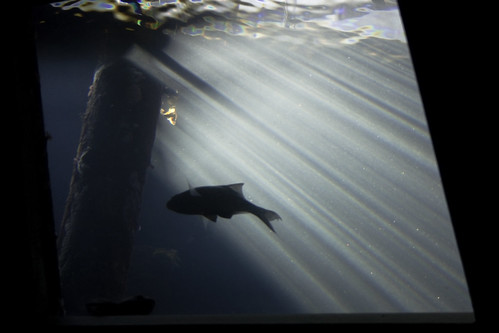
So I broke out my gen-chem book, and found out I was mistaken -- the difference between colloids and solutions is the size of the molecules, or groups of molecules. In both, a molecule or ion is solvated, or completely surrounded by the solution. But in a colloid, the groups of molecules are much larger, between 1 * 10^3 pm to 1 * 10^6 pm (picometers). For comparison, the bond length of a Helium to Helium molecule is 300 picometers. Another common example of a colloid is found in soap -- when soap molecules interact with grease, they embed into the grease while keeping a single part of the soap molecule on the outside of the grease. The part embedded in the grease is attracted to oily things, and the part on the outside of the grease is attracted to water -- so running water will then push the grease along. This is a colloid composed of a clump of molecules attracted to each other, but dispersed in another medium, and much larger than a molecule in a solution. Another good day-to-day example of colloids can be seen if you go for a walk at the park. If you've seen light streaming through the branches, this is because the light is reflecting off of dust in the air. In fact, this is a common way to distinguish between colloids and solutions, and is known as the Tyndall effect (this picture demonstrates a colloid of a solid in a liquid). The molecules in a solution are so small that they don't interfere with the visible light spectrum, but the molecules or groups of molecules in a colloid are large enough to do so.

So this brought me to another question regarding chemical philosophy: While we can observe the Tyndall effect to distinguish between colloids and solutions, do the sizes of the molecules matter very much aside from the fact that they interact with visible light? I've done kinetics experiments revolving around a solutions ability to absorb light. So, even though we can't observe the interaction with our eyes, the molecules do still interact with light, don't they? Is the terminology of solutions a bit too simplistic? After all, there is a point in solutions where you have to ask, what is the solvent and what is the solute? What if you have more than two liquids and a solid? Proteins can grow to reach sizes like this, and yet they are only one molecule solvated by water. Does that make our DNA colloidal, and what point does this distinction elucidate? After all, we could also just say that solutions with really big particles in them interact with the visible light spectrum and be done with it. But then we'd be expanding the terms of solution to include things that are clearly not mixed in the same way that salt water is mixed, such as mayonnaises, or beer foam. But they are also slightly different from a solid block of, say, iron. But just because there seems to be this odd in between zone where we're uncertain about how to classify and understand given solutions, it seems rather ad-hoc to just make up a term and rationalize a distinction. So, what's the point of colloids, and what terms should we use in distinguishing between types of solutions, if indeed we ought to revise them at all? I'm going with the ambiguous and open-ended ending.